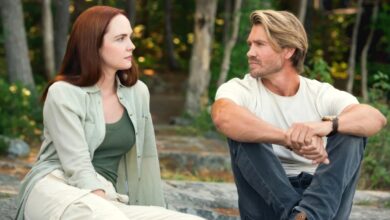
Sullivan’s Crossing, Andrea Menard made us emotional wrecks as her character Edna Cranebear needed surgery to have a tumour removed that was causing vision loss. But the Métis artist from Manitoba has been captivating audiences for decades as one of the country’s most accomplished talents.
Before Sullivan’s Crossing, Menard was on shows like Moccasin Flats, Rabbit Fall, Blackstone, Arctic Air and Supernatural, to name just a few. Reflecting on her journey to become a beloved performer, Menard said it began with her watching her parents sing as she was growing up.
“My dad was the king of the kitchen party and my mom harmonized,” she told Yahoo Canada. “I did plays for the neighbourhood kids. I got everyone involved. … I would record little backtracks for us to perform to.”
“It’s like these two parts of me were growing at the same time,” she said. “But as a child, singing probably was the most obvious.”
“I tell people that my singing was always connecting me with creator, with spirit. … Acting and storytelling was my way to delve into the curiosity of human behaviour. … I was a bush kid. I had no idea that industries existed in Canada. … I wasn’t exposed to much professional theatre as a kid. We moved around a lot and in small towns. So in university is when my whole world opened up and I discovered the film industry, the theatre industry, the music industry, all at the same time.”




It was while she was a university student in Saskatchewan that Menard got her first film role, her first lead theatre role and her first music gig. From there her name was “spread around” in the community for any use of her artistic talents.
“[Saskatchewan] was a thriving community. … Then it was also the beginning of APTN [Aboriginal Peoples Television Network], … and that was at the beginning of a renaissance of Indigenous filmmakers, and directors and writers and actors all finally having a platform where we had a voice, we had a place to play and to increase our abilities together.”
But as her career started to take off, Menard had to navigate the risks of the entertainment industry, doing so by, as she described, giving away her career.
“I always tell people … in the beginning of my career, when I started to see what the industries were like, meaning that they seemed like a dangerous place for me, I don’t know if I’ll survive this. I don’t think I have the confidence or the beauty, or the colour of skin,” Menard said. “I thought it could be a dangerous place for my safety, maybe not physical safety, but spiritual safety maybe, if that’s a way to look at it.”
Yahoo Canada’s Eh Listers is an interview series with women and non-binary Canadians in film and television, looking back on their careers with unfiltered stories about their greatest projects.
Moccasin Flats — 2003 to 2006
A particularly celebrated project Menard was in was Laura Milliken and Jennifer Podemski’s series Moccasin Flats. At the time, it was praised for being a show with an Indigenous cast, written and produced by Indigenous talents, and given a mainstream platform to share the story of a community in a Saskatchewan town.
“It was enormous … and it was the first of its kind,” Menard stressed. “It was the first directed, produced and acted with … an Indigenous team, with a focus on Indigenous stories told through our lens. And it was a big deal.”
Looking at where Indigenous stories being told by Indigenous creatives have come since a project like Moccasin Flats, Menard stressed that the younger generations are blowing her away.
“They have no time for our stories being told by other people,” Menard said. “I’ve had to learn from them, because I learned that it’s a job, and I learned that from the generation before me, because the generation before me, they didn’t see that change happening. They prayed for it, they asked for it, and they were always encouraging young people to get into the business.”
“The generation of kids that grew up on APTN, who actually grew up with all sorts of comedies, dramas, news, documentaries, … reality shows, … all of a sudden they knew they had a right to be on those screens, which is what [my generation] and above didn’t necessarily know yet. So change is most needed, but it’s happening because the younger generation is going, ‘No more.’ … There’s still a lot of work to be done, but the next generations are really inspiring.”
Rabbit Fall — 2006 to 2008
Menard starred in the 2006 movie Rabbit Fall, which then became a series that ran until 2008. She played Tara Wheaton, a Métis cop in a community with a history of violent crimes and suspicions of supernatural activity.
“That was a magical show, because I love fantasy. … The fact that an Indigenous-created film and TV series was being birthed was so great. … Rabbit Fall had a real, unique and Indigenous way of approaching this storyline. It was great. … Land and ancestors and trauma, stuff that needed to be healed.”
Reflecting on the circumstances that make Menard feel safe to go to particularly emotional or traumatic places for her characters, the actor says that’s an area where there’s been a “generational shift.”
“[I] grew up in a generation where you just dealt, you just had to deal. And so we did. … We used the tools we had and created tools to go through those hard scenes, those hard things to do,” she shared. “But I would say, nowadays, there’s so much more information about how to handle it, re-triggering of intergenerational trauma and all those things that affected all of us.”

The Velvet Devil — 2006
The project that Menard calls the “biggest expansion” of her life was working on The Velvet Devil, her one-woman musical that toured across Canada before becoming a TV movie that aired on CBC. It’s also one of Menard’s albums.
“She came as a character haunting me, this velvet woman. … I hadn’t been a writer yet. … And I said, if I’m going to do this, then it has to matter. It actually has to make an effect for the betterment of the world, or I’m not doing it, because it’s too hard,” Menard said. “But I was given a picture of everything. I saw a CD, I saw a theatre play, and I thought I saw a film of it, and I went, OK, well, if it’s going to get done, then you have to write it.”
Menard’s first task was writing the theatre play, which included a lot of music. Eventually, it transformed from a play to a movie, a radio show and a CD.
Sullivan’s Crossing — 2023 to present
Now Menard portrays the beloved character Edna in the hit show Sullivan’s Crossing.
Edna is very much the glue that keeps the community together, with her relationship with husband Frank, played by Cree actor Tom Jackson, being a particularly beautiful part of the story. While Maggie (Morgan Kohan) and Sully (Scott Patterson) are navigating all these shifts and changes in their lives, Edna and Frank are that loving and grounded constant of the series.
“When I auditioned for it, I knew nothing. … [But I] want to play an auntie that’s just loving and fierce … No one’s getting murdered. I don’t want any missing and murdered Indigenous women. I wanted to have a loving, healthy … couple on camera,” Menard said. “When I saw what they were creating, … showrunner Roma Roth, she was so open to Indigenous conversations and content.”
“We’re filming in Mi’kmaw territory, and I was like, I don’t want to play a Mi’kmaw character. If you’re going to have a Mi’kmaw character, you should hire a Mi’kmaw person, because the time of specificity is upon us. … But [Roma Roth] said, well, why can’t we just have … Métis and Cree characters. I sobbed. Because I went, well, that never happens,” Menard said. “So the fact that I could just be a Métis character living in Mi’kmaw territory, just like I live in Vancouver, I’m a Métis person living here in the unceded traditional territory of the Squamish. … So once that was established, there was this relaxation into the part of, OK, I can help build this character from the ground up. I don’t have to be anybody’s expectation. We can make sure that it’s authentic to my community as well as to my heart, and to the story.”